
What Do Representation Gaps Reflect?
On Information Asymmetries, Value Differences and Genetics

The Undisclosed Struggle Over Democracy
Part of the reason why a large and increasing share of voters support populist parties is that they fill representation gaps that other parties have left open. On cultural issues, like immigration, nearly all mainstream parties are much more left-wing, while most voters and populists are right-wing. This representation gap between mainstream parties and voters causes them to support populists. I have written this post to explain how this process played out in Germany.
While people across the political spectrum increasingly realize that representation gaps exist and play a major role in the rise of populism, there is stark disagreement on how to interpret them. These diverging interpretations can be neatly linked to two model classes in the field of political economics. Political economists build models to understand how democratic elections work. Such elections usually feature candidates who propose different policies, and voters differ in their preferences toward these policies. However, why would voters’ preferences differ?
This question may seem trivial or innocent, but I think it is of great practical relevance as it helps to understand an undisclosed struggle lying beneath political competition in the Western world.
One can broadly distinguish two classes of election models by where they assume preference heterogeneity to come from. Some models assume that voters have fundamentally different preferences, for instance, due to differing economic interests (e.g., the poor benefit from redistribution while the rich do not). In these models, there is no right or wrong policy. Other models assume that there is an objectively “true state of the world” such that some policies are objectively right while others are just wrong. All voters, in principle, would want the same objectively right policy. However, their stated preferences differ because some are misinformed or stupid.
People interpret representation gaps completely differently depending on which of these models they (implicitly) employ. Those who believe in the first model class interpret representation gaps as clear evidence that mainstream parties are undemocratic, possibly corrupt, or tyrannical. From their perspective, there is little difference between mainstream parties and the Chinese or Russian Communist Party. In contrast, people who believe in the second model class think that representation gaps just reflect politicians being smarter or more informed than voters. These people do not see representation gaps as a problem. I think the argument on who is right on that matter constitutes a (yet) undisclosed struggle of the Western world.
Elites Against the Majority
This undisclosed struggle pits mainstream politicians and educated elites on the one hand against ordinary people and some populists on the other hand. For instance, assume that a parliamentarian holds a different personal opinion from his voters. Should he follow his own or his voters’ opinion? To find out what people think, research teams from several countries asked members of their parliament and voters, via anonymous surveys, the following question:
How should, in your opinion, a member of the ... Parliament vote if his/her own opinion does not correspond with the opinion of her/his voters?”
own opinion
voters’ opinion
The results show that the majority of European parliamentarians think that MPs should follow their own opinion, while most voters think otherwise.
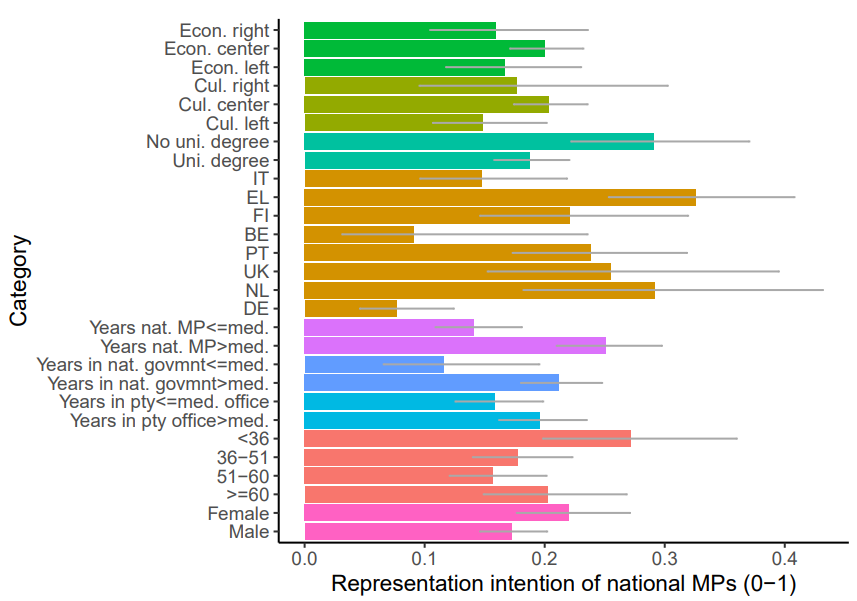
Figure 1 shows how the share of parliamentarians who think that MPs should follow their voters differs by demographic groups and country. For instance, German and Belgian MPs are particularly unwilling to follow their voters, and those with a university degree or those who spend more time in politics care less about their voters’ opinions. Despite this variation, the vast majority of MPs from each group seems to prioritize their own opinion over the opinions of their voters.
Notably, parliamentarians from populist parties are not entirely different. Even among them, about half think that an MP should follow his own opinion. This share is much lower than among mainstream politicians but much higher than among voters.
What Do Scholars Believe?
My perception is that modern Western scholars, along with journalists and politicians, overwhelmingly believe that the second model class relies on the more realistic assumption about preference heterogeneity.
For instance, consider the rise of populism. Most theoretical explanations scientists have proposed for the rise of populism, and particularly the most prominent and well-published explanations, assume that some share of voters -the share that votes for populists- does so because of some form of cognitive error. However, these papers do not provide notable empirical evidence for this assumption. This assumption can therefore be understood as a belief that scientists and much of the Western elite hold at the moment.
This belief matters because it provides the justification for several controversial policies. For instance, if there exists an objectively correct policy that some voters fail to recognize, the job of a politician is primarily to find this policy purely on a review of the academic literature and to educate anyone who dislikes the result. This line of reasoning places little emphasis on preference aggregation, much emphasis on the fight against misinformation, and provides an argument for more power in the hands of politicians.
Heterogeneity in Values
This note does not seek to establish which class of models is more likely to be true. I also do not dismiss the relevance of cognitive biases or the idea that some policies are objectively better than others. However, I want to summarize evidence suggesting that the first class of models does capture a notable part of reality that is often ignored. Preferences do differ fundamentally between people, even if they receive the same information.
By “differ fundamentally”, I mean that they are the result of differing underlying values and therefore deeply ingrained in the corresponding people. I think, for example, about moral values. Such differences are like tastes in food. In most cases, there is no best food because tastes are subjective. For example, this book, which summarizes insights from moral psychology, compares basic moral values to flavours. For some people, moral behaviour is only about preventing harm, while for others, it is more immoral to disrespect authorities in the same way that some people like sweets, while others prefer salty food.
Similarly, economists have found that some people believe that goods should be distributed among people based on the effort they put into producing the goods, while others feel that goods should be distributed equally, independent of relative efforts (if you want to read more on this, read my article here). Yet another example is that some people find efficiency more important than equality, while others prioritize equal distribution. Each of these values has been shown to be of primary importance for political attitudes and voting.
Genetic Origins of Values
Such differences in tastes, values, and fairness views are to a large part determined genetically. A huge meta-analysis of twin studies finds that roughly half of all differences in personality traits between humans are due to genetic differences. Many such personality traits are therefore stable over the life cycle and hard to change. In particular, twin studies have revealed that political orientations are genetically transmitted. Hence, two children who are raised identically and receive the exact same political information will very likely still disagree strongly politically.
Are Representation Gaps Due to Information or Value Differences?
What do representation gaps reflect: information asymmetries or value differences between voters and parliamentarians? The existing evidence does not allow for a conclusive answer. However, some observations are noteworthy.
First, Parliamentarians are even more in favor of immigration and multiculturalism than voters with very similar demographics as politicians, well-informed voters, or immigrants themselves. Representation gaps decline when comparing these groups to MPS, but much of the gap survives. This is consistent with the idea that both models contain some truth.
It is also notable that (those who will become) top politicians are much more risk-loving and efficiency-oriented than ordinary people, and they have different Big Five personality traits. That means that even if politicians and voters had experienced the exact same environmental influences throughout their lives and, in particular, access to the same information, their political attitudes would still differ.
Two Helpful Analogies
I think a memorable and vivid analogy of the current behavior of mainstream politicians is a joint restaurant visit. If a group of ten people decides on what restaurant to go to, it must, to some extent, aggregate the preferences of its members. Some group members might be allergic to some type of food or be vegetarians. Taste also plays a role. Even though the city might have a fabulous sushi restaurant, some group members might simply not like fish. Of course, some restaurants might clearly be better than others, and the opinion of a well-educated group member should be considered. However, it would be a bad idea in most cases to just let the smartest or most educated member decide where to go against the objection of other members.
While it seems obvious in this example, it doesn’t seem to be obvious to many mainstream politicians when it comes to immigration politics, punishment for criminals, and many other cultural topics. Phenomena like immigration are complex and have many effects, some of which are positive while others are negative. Without knowing exactly how people weigh these concerns relative to each other, it is impossible to know which policy is in their interest. If you want more details, check out this post in which I argue that the immigration attitudes of voters actually make a lot of sense. Yet, without knowing what people want, mainstream politicians all too often reject opposing attitudes as mis- or disinformation.
To get back to our restaurant example, assume that you don’t like fish and that the group member who knows most about food overrides your concerns with the statement “you are just uneducated,” after which he leads the group to the Sushi place. Such behavior adds insult to injury because it is not only against the interests of the people but also disrespectful to their individual preferences. In the case of mainstream politicians, the situation is even worse since they rely on votes and taxes from citizens.
Politicians can alternatively be compared to a waiter who insists that a salad is the best option without an alternative and, based on this assessment, refuses to bring his customer the steak he ordered. Not surprisingly, the customer might be seen at a fast food chain instead of coming back another time. In my assessment, the behavior of mainstream politicians is just as self-damaging as the behavior of this waiter. It is driven by the inability to understand that preferences fundamentally differ and cannot be changed easily through argumentation. Just as it is nearly impossible for a waiter to convince a meat lover to choose the salad over the steak, politicians will not convince a conservative voter to become liberal. Mainstream parties have to decide whether they want to deliver the policies people demand, or they will be replaced by someone who does, even if these alternatives are far inferior in other ways.
This line of reasoning leads to the question of how (in)effective media campaigns and propaganda are. I summarize evidence on that question in this post. If you want to read more about heterogeneity in fairness preferences and how they evolve over the life cycle, you can check out this post.
I think it’s odd lawmakers openly indicate they would/should vote their own beliefs over their voters where/when they differ. Maybe there’s a language barrier happening. To me, the politician’s entire job is to represent their constituency and not themself. For example, Senator Lindsey Graham here in America doesn’t like President Trump. Yet most people in his state love President Trump, so Mr. Graham supports Mr. Trump. He has to or he’d be out of a job.
One problem I see with wanting lower immigration is the negative feedback of too low immigration might operate on a longer time horizon than the election cycles. I don’t think many people alive today know why countries like Germany started bringing in so many immigrants in the 1960s and 1970s. Nor do they know why asylum policy was enacted. So populists can run on this and be disruptive and then when it’s a terrible idea they never face the consequences.
Another problem with wanting lower immigration is the people might actually want fewer immigrants. By that I mean removing immigrants (mass deportations). We see this historically with anti-Chinese sentiment in cities like Seattle and San Francisco. Alcohol prohibition in America was also maybe partially motivated by anti-Catholic (Irish/Italian) sentiment. Liberia was founded as a place to “return” African slaves. Plus before Indian schools we had the “Trail of Tears.”
Bryan Caplan has written about the irrationality of voters in his book The Myth of the Rational Voter, and Jason Brennan discusses the stupidity and sheer ignorance of voters in his book Against Democracy. There is also a well-developed literature on rational ignorance, notably by Ilya Somin. This line of thinking has deep roots in American libertarian thought—and, importantly, they are mostly right.
Additionally, there is Larry Bartels’ book Democracy for Realists, which examines how voters actually behave.
Conventional theory (folk theory):
Voters know their interests.
They gather information.
They evaluate party platforms and policies.
They vote for the candidate or party closest to their preferences.
Achen & Bartels’ findings:
Most voters have low political knowledge.
They cannot accurately describe party positions.
They rarely change their vote based on specific policy issues.
👉 Bottom line: Voters do not behave like rational, well-informed decision-makers.
🪧 2. People vote based on group identity, not issue positions
Party identification functions like a social identity (e.g., religion, ethnicity, class), not just a bundle of policy preferences.
People adopt opinions that align with their group, rather than choosing groups based on their prior beliefs.
Voting becomes a way of expressing loyalty to one’s “team” rather than evaluating policy platforms.
🧭 Example:
A voter who identifies as conservative or Christian is likely to support the right-wing party even if they disagree on certain policy points—because group loyalty outweighs issue divergence.
If average voters were fully in charge, we would not have institutions like the WTO or the EU, nor would we see a relatively smaller state or freer markets in the U.S.
I think elites are, for the most part, correct in being free-market friendly and socially liberal.
There is no democratic solution here, given the practical realities of how politics actually works. No American voter supported the consequences of the Hart-Cellar Act—the legislators themselves believed it was merely a mild immigration reform—but it ended up transforming U.S. demographics and contributing to the "Brazilianization" of America.
I think the issue is that elites don’t feel the consequences of their policies the way the working class does. For example, white liberals often flee non-white neighborhoods—even more so than white conservatives—and live in gated communities, employing non-white nannies, while remaining insulated from immigrant-related crime.
Also, there is likely a genetic component. At least in the U.S., and in my opinion in Europe as well, elite types tend to be genetically predisposed toward liberalism, especially social liberalism. Even conservative elites in America are often uncomfortable with Trump and only support and vote for him covertly.
I think the issue of immigration is different from any other issue—such as housing, inflation, or taxation. Immigration has deeper cultural, demographic, and long-term societal implications. We need to convince a segment of the elite about the seriousness of immigration issues, as well as related problems like wokeness, which is becoming increasingly polarizing and fracturing society.
Recently, Nathan Cofnas wrote a compelling article laying out a pathway to achieve this. But with the ongoing influx of immigrants, it is becoming increasingly difficult to reach a societal consensus.
I believe there is a need for consensus on this issue—something akin to what we see in Denmark, to some degree.
LINKS
*https://ncofnas.com/p/beating-woke-with-facts-and-logic
* ON BIOLOGY OF POLITICAL DIFFERENCES -https://www.amazon.com/Predisposed-Liberals-Conservatives-Political-Differences/dp/0415535875
P S - Also, there is literature suggesting people choose party first and adjust views later.
* https://www.sciencedirect.com/science/article/abs/pii/S0167268120303413
* https://ed.stanford.edu/sites/default/files/party_over_policy_0.pdf
* https://www.annualreviews.org/content/journals/10.1146/annurev-psych-030424-122723
* https://journals.sagepub.com/doi/abs/10.1177/0956797618805420